
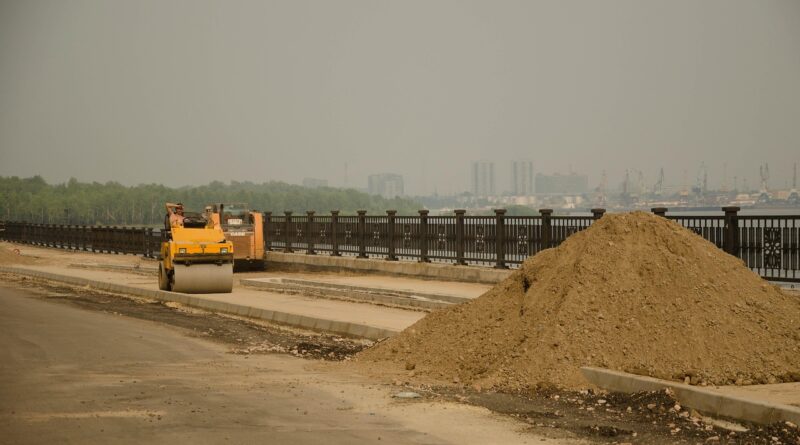
How an asphalt paver works and what affects mat quality
What an asphalt paver does
An asphalt paver receives hot or warm asphalt mix, moves it through the machine, spreads it across the lane or work area, and uses a screed to form the loose mat before rollers complete compaction. For contractors, inspectors, and equipment buyers, the practical point is that the paver does not work by itself. Mat quality depends on the full paving train: plant output, haul trucks, the paver, screed settings, crew decisions, rollers, weather, and timing. Federal Highway Administration guidance for asphalt construction repeatedly emphasizes steady truck delivery, a sufficiently full hopper, a near-constant auger material level, proper mix temperature, rolling patterns, and surface checks for tearing, cracking, and segregation. (fhwa.dot.gov)
On a jobsite, the asphalt paver is the visible center of the operation, but it also serves as a diagnostic point. Streaks, waves, segregation, screed marks, stop-start bumps, and poor joint transitions usually point to a process problem, not one isolated machine setting. For more equipment explainers and machinery context, see the Equipment & Machines section on MechMeld.

Main parts of an asphalt paver
Most asphalt pavers can be understood as two connected systems: the tractor and the screed. The tractor provides mobility, receives the mix, and conveys material to the rear. The screed floats behind the tractor, shapes the mat, and provides initial compaction. The National Institute for Occupational Safety and Health describes an asphalt paver as a self-propelled machine, either rubber-tired or crawler-mounted, designed to receive, convey, distribute, profile, and compact paving material by the free-floating screed method. (cdc.gov)
Hopper and truck interface
The hopper is where the mix first enters the paver. Its role is not just storage; it helps buffer the flow between haul trucks and the paving machine. If the hopper runs too low, if trucks bump the paver, or if material cools or segregates before it reaches the conveyors, the screed receives an inconsistent feed. That inconsistency can appear as texture changes, thickness variation, or roughness in the finished mat.
Conveyors, flow gates, and augers
Conveyors or slat feeders move asphalt from the hopper to the rear of the machine. Flow gates and feed controls regulate how much material reaches the auger chamber. Augers then distribute the mix across the paving width. FHWA inspection guidance asks whether the hopper is kept sufficiently full to prevent nonuniform flow and whether the level of material in the augers is kept near constant. These checks matter because the screed reacts to changes in the head of material in front of it. (fhwa.dot.gov)
Screed and extensions
The screed determines much of the mat profile. It affects grade, cross slope, width, texture, and initial density. Screeds may include vibration, tamping bars, heating systems, crown adjustment, strike-offs, and extensions. A well-maintained screed can place a consistent mat. A cold, worn, warped, or poorly adjusted screed can cause dragging, tearing, lines, or irregular texture.
Settings and jobsite factors that control mat quality
The paver operator and screed operator manage several variables at the same time. The goal is not to chase every minor surface mark with constant corrections. It is to keep feed, speed, temperature, screed attitude, and rolling timing stable enough for the mat to remain uniform from truck to truck.
Continuous paving speed
Uniform speed is one of the simplest paving principles and one of the hardest to maintain in the field. The paver should move at a rate that matches plant production, haul distance, truck cycle time, lift thickness, lane width, and the roller train. The FHWA thin hot-mix overlay checklist states that sufficient trucks should be available to allow the paver to keep moving at a uniform speed. The same checklist identifies multiple paver stop-starts and excessive paver speed as common causes of poor smoothness or a rough ride. (fhwa.dot.gov)
Temperature window
Asphalt mix must remain workable long enough to be placed and compacted before it cools beyond the effective rolling window. Lift thickness, wind, humidity, cloud cover, surface temperature, haul time, and mix type all affect cooling. FHWA preservation checklist guidance notes that temperature, wind, humidity, sun or cloud cover, and lift thickness influence how quickly a mix cools and how much time is available for compaction. (fhwa.dot.gov)
Screed preheat and automatic controls
A cold screed can drag mix and create surface defects at startup. FHWA checklist guidance calls for the paving screed to be preheated before placement and says automatic screed control should be used whenever possible; if manual controls are used, frequent changes should be avoided. The broader principle is straightforward: stable automatic control usually supports smoother results than reactive manual correction. (fhwa.dot.gov)
Matching the asphalt paver to the work
Not every paving job needs the same machine. A highway resurfacing project, an airport shoulder, a subdivision street, a parking lot, and a narrow utility patch place different demands on traction, paving width, truck access, grade control, maneuverability, and production rate.
| Job type | Paver considerations | Why it matters |
|---|---|---|
| Highway mainline paving | High production, stable traction, automatic grade and slope control, coordinated truck flow | Smoothness, density, and lane continuity are usually critical acceptance factors |
| Urban streets | Maneuverability, joint control, utility clearance, shorter pulls | Frequent starts, intersections, and obstructions increase the risk of surface variation |
| Parking lots and commercial sites | Variable widths, tight turns, edge control, handwork coordination | Grade transitions and drainage details often matter as much as production speed |
| Thin overlays | Careful temperature management, clean surface, tack coat quality, correct screed setup | Thin lifts cool quickly and leave less margin for correction before compaction |
| Specialty or narrow work | Compact paver size, access, steering, and crew handwork | Oversized equipment can reduce control in confined areas |
A material transfer vehicle can be used between haul trucks and the paver on some projects. Its purpose is to improve delivery continuity, provide surge capacity, and reduce some forms of segregation. It is not a fix for every paving issue, and it adds cost, space requirements, and coordination needs. The case is strongest when smoothness, thermal uniformity, truck cycling, or agency specifications justify the extra machine.
Quality checks before and during paving
The most useful asphalt paver inspection is not a one-time startup checklist. It is a series of repeated checks before paving, at startup, during truck exchanges, behind the screed, and during rolling. FHWA thin overlay checklist items include confirming that the paver is well maintained; checking tires or tracks, auger, screed, flow gates, and slat conveyor; verifying that mix is placed at proper grade, cross-slope, and thickness; and checking that surface texture is uniform and free of segregation, tearing, or scuffing. (fhwa.dot.gov)
| Checkpoint | What to observe | Likely issue if ignored |
|---|---|---|
| Truck arrival pattern | Enough trucks to keep the paver moving steadily | Stop-start marks, temperature loss, roughness |
| Hopper level | Consistent material supply without starving the conveyors | Nonuniform auger feed and mat texture changes |
| Auger chamber | Material kept at a stable height across the screed width | Longitudinal streaks, segregation, thickness variation |
| Screed heat and condition | Preheated plate, clean extensions, no obvious wear or warping | Dragging, tearing, poor startup texture |
| Mat behind screed | Uniform texture, no open areas, no excessive scuffing | Density variability and early distress risk |
| Roller timing | Breakdown rolling starts while the mat is still workable | Insufficient density or roller marks |
Technology changing asphalt paver operation
Digital tools are making paving less dependent on visual observation alone. Thermal profiling uses infrared sensor technology integrated into the paving process to measure asphalt mat temperatures. FHWA intelligent construction equipment guidance describes infrared sensors or scanners mounted on a paver to take continuous surface temperature readings with GPS location reference. The same guidance explains that processed readings can show temperature differentials behind the paver before breakdown rolling and can support adjustments such as screed setup, screed maintenance, truck practices, use of a material transfer vehicle, or additional delivery trucks. (fhwa.dot.gov) See also: CNC Machining.
Warm mix asphalt is another important development because it changes the temperature and workability equation. FHWA describes warm mix asphalt as a group of technologies that allow producers to lower mixing and placement temperatures. Its Every Day Counts material states that warm mix production methods use temperatures 30 to 120 degrees Fahrenheit lower than traditional hot-mix asphalt, can improve compaction, can extend the paving season, and typically reduce fuel consumption during manufacturing by about 20 percent. (fhwa.dot.gov)
Worker exposure controls also belong in the equipment discussion. NIOSH engineering control guidelines for hot-mix asphalt pavers were developed through a government, industry, and labor effort to reduce exposure to asphalt fumes during paving operations. For modern machine evaluation, ventilation, operator position, visibility, access, and safe service points should be considered alongside production metrics. (cdc.gov)
Common mat problems and likely causes
Surface defects behind an asphalt paver should be treated as clues. They do not always identify one cause, but they narrow the search. A mat can look poor because the mix is too cold, the screed is improperly set, the head of material varies, trucks are poorly loaded, the paver speed changes, or rolling is mistimed. FHWA checklist guidance on common problems links segregation to loading and unloading practices, hopper wing handling, and material management, while roughness can be associated with stop-start paving, excessive paver speed, improper manual screed control, roller speed, or poor joint practices. (fhwa.dot.gov)
| Observed problem | Potential causes to investigate | Practical response |
|---|---|---|
| Coarse or segregated areas | Truck loading pattern, material transfer, hopper wings, auger feed, temperature differentials | Review loading drops, keep flow stable, consider transfer equipment where justified |
| Tearing behind screed | Cold mix, cold screed, dirty screed plate, incorrect angle, harsh mix, thin lift cooling | Check temperature, preheat, screed condition, and paving speed |
| Waves or ripples | Speed changes, overcorrection, screed instability, inconsistent head of material | Stabilize paving speed and minimize unnecessary manual screed changes |
| Longitudinal streaks | Auger segregation, worn components, extension setup, flow imbalance | Inspect augers, extensions, strike-offs, and feed sensors |
| Poor joint transition | Incorrect overlap, poor edge confinement, delayed rolling, low density at joint | Coordinate paver alignment, raking, and joint rolling sequence |
What equipment buyers and project teams should prioritize
When evaluating an asphalt paver, buyers often start with horsepower, paving width, hopper capacity, and brand support. Those factors matter, but the more practical question is whether the machine can hold a stable process on the work the company actually performs. A good paver for a contractor is one that can feed the screed consistently, maintain grade and slope, match expected production, fit site constraints, and be serviced without excessive downtime.
Project teams should also avoid treating the paver as a substitute for planning. Even a well-equipped machine will struggle if the plant cannot supply consistent mix, trucks arrive irregularly, the base is not ready, the tack coat is poor, the surface is wet, or the roller train cannot achieve density in the available temperature window. The strongest paving outcomes come from aligning the full system before the first truck unloads.
Frequently asked questions
What is the difference between an asphalt paver and a roller?
An asphalt paver places and shapes the loose mat. A roller compacts that mat to reach the required density and surface finish. The paver provides initial compaction through the screed, but final density depends on the roller pattern, roller type, timing, temperature, and lift thickness.
Why does an asphalt paver need to keep moving?
Continuous motion helps maintain smoothness, uniform temperature, and consistent screed behavior. Repeated stops can create bumps, cooling zones, and texture changes, especially when trucks are not coordinated with plant production and paving speed.
Does a wider paver always improve productivity?
No. Wider paving can reduce joints and increase production on open work, but it also requires enough mix delivery, roller capacity, crew control, and site access. If the paving train cannot support the width, mat quality can suffer.
Can technology replace operator skill?
No. Thermal profiling, automatic grade control, feed sensors, and data systems can reveal problems faster and help crews make better decisions. They still depend on trained operators, maintained equipment, good setup, and timely field adjustments.
What is the main takeaway for asphalt paver performance?
The asphalt paver should be evaluated as part of a paving system. Machine condition matters, but the best results come from steady material delivery, stable screed control, correct temperature management, coordinated rolling, and continuous quality checks.